PhD Research Update by Ellen O’Brien | Update: July 2026
This PhD research explores how Learning Disabled* young people express creative ideas through music, and how musicians can support that creativity in special school settings. The research uses data collected through two Count Me In! song-making projects co-led by Ellen O’Brien with musicians from Live Music Now at special schools in Somerset and London.
Research questions
The PhD asks three questions about creativity, student voice and interaction in group song-making sessions:
- How do Learning Disabled students express their ideas or choices?
- How do students’ ideas or choices interact with those of others?
- What strategies can music practitioners use to facilitate this interaction of ideas or choices to make songs?
Research progress
- Jan-Aug 2025: Planning of research methods, literature review and ethics.
- Sep-Dec 2025: Data collection Stage 1: project at Polden Bower School (Somerset).
- Jan-Apr 2026: Data collection Stage 2: project at Wembley Manor School (London).
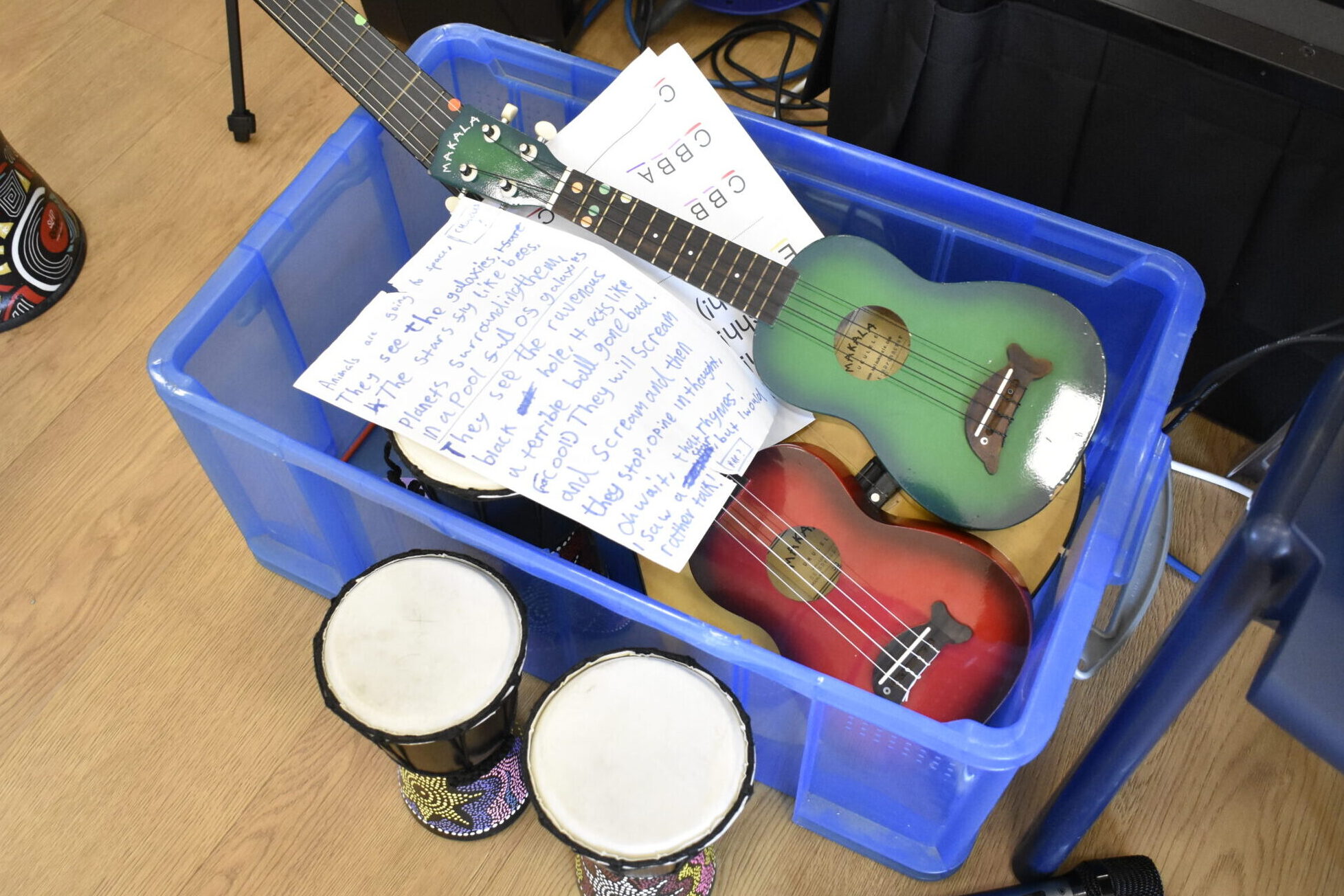
Across the two special schools, 26 students aged 9–13 took part in 10-week group song-making projects. Together with musicians, students created new songs while the researcher observed how ideas, choices, sounds, gestures and interactions developed during the sessions.
The projects generated more than 45 hours of video footage, including recordings of music sessions and musician planning meetings.
Research methods
Research methods were designed to be flexible, inclusive and responsive to students’ communication styles.
- Visit classes: Observe student communication styles to learn how to make methods inclusive.
- Song-making project: 10-week music project with video observations, field notes and weekly reflections from musicians.
- Reflections: Interviews with students and musicians using a range of communication methods. Watching video footage with students enables them to reflect together on what was happening and how they felt.
Next steps
The next stage is analysis. Ellen is transcribing videos and audio recordings, including speech, sounds, actions and gestures. She will then use Reflexive Thematic Analysis to identify themes and contrasts across the data, with a focus on expression, interaction and teaching approaches.
Student voice
Early analysis of student interviews highlights the importance of recognising student voice in many forms. These examples come from relaxed interviews where students watched videos of their performances and reflected on what they saw.
“I was so excited, I was rocking myself because I was excited, I was very excited for our performance, I felt very happy [rocks in chair and smiles].” (Kayla)
[Song starts, immediately student smiles, points to the screen] “That’s me!” [smiling and laughing] “That’s me, that’s me. That’s me!” (Jayden)
Why this research matters
Music can offer flexible, non-verbal and collaborative ways for students to take part, communicate and learn together. However, Learning Disabled students can still face barriers to accessing meaningful music education.
Group songwriting can make students’ choices and contributions immediately audible to others. Existing research suggests that making songs together can support collaboration, confidence and self-expression.
There are still relatively few studies exploring creativity among Learning Disabled students or within special schools. This research aims to contribute new insight into how creativity happens in these settings and how music practitioners can make song-making more accessible.
Research aims
- To further understand how people are creative.
- To make music sessions more accessible.
Key themes
- Songwriting (composition, songmaking, co-creation)
- Creativity (musical flourishing, meaning)
- Agency (youth/student voice, ownership, identity)
- Inclusion & Disability (Disability studies, access)
Recent presentations
- Artists in Schools Research Network (Goldsmiths & Curious Minds, Feb 2026)
- SEMPRE Conference – Poster Presentation (Cambridge, April 2026)
- SENSS Conference – Presentation (South & East Network for Social Sciences, July 2026)
*The term ‘Learning Disabled Students’ is used to align with the Social Model of Disability which recognises that people are disabled by barriers in society.